Connect Google Sheets

Import your workers and the credentials they hold straight from a Google Sheet. You fill in Oho's template, share the sheet, and Oho creates your workers and starts verifying the credentials you've listed for them.

It works just like the Excel import, but reads a live sheet — handy if your team already keeps its workforce list in Google, since there's no file to host or re-upload.

What you'll end up with

Your whole workforce in Oho — each person a worker, with their credentials added and checked — without typing anyone in by hand.

Before you start

You'll need:

  • Your list of workers and the credential details you hold for them — names, dates of birth, organisation, and any card or registration numbers.
  • A Google Sheet in Oho's template format. The template has two sheets — a Workers sheet and a Credentials sheet — with fixed column headings. See Map the sheet below.
⬇ Download the template (.xlsx)

To use it in Google, upload the template to Google Drive and open it as a Google Sheet.

Prefer a file?

If you'd rather host a file than a live sheet, Excel works exactly the same way and reads an .xlsx you host on OneDrive.

Oho reads your Google Sheet over a share link, so the sheet needs to be reachable by anyone holding the link:

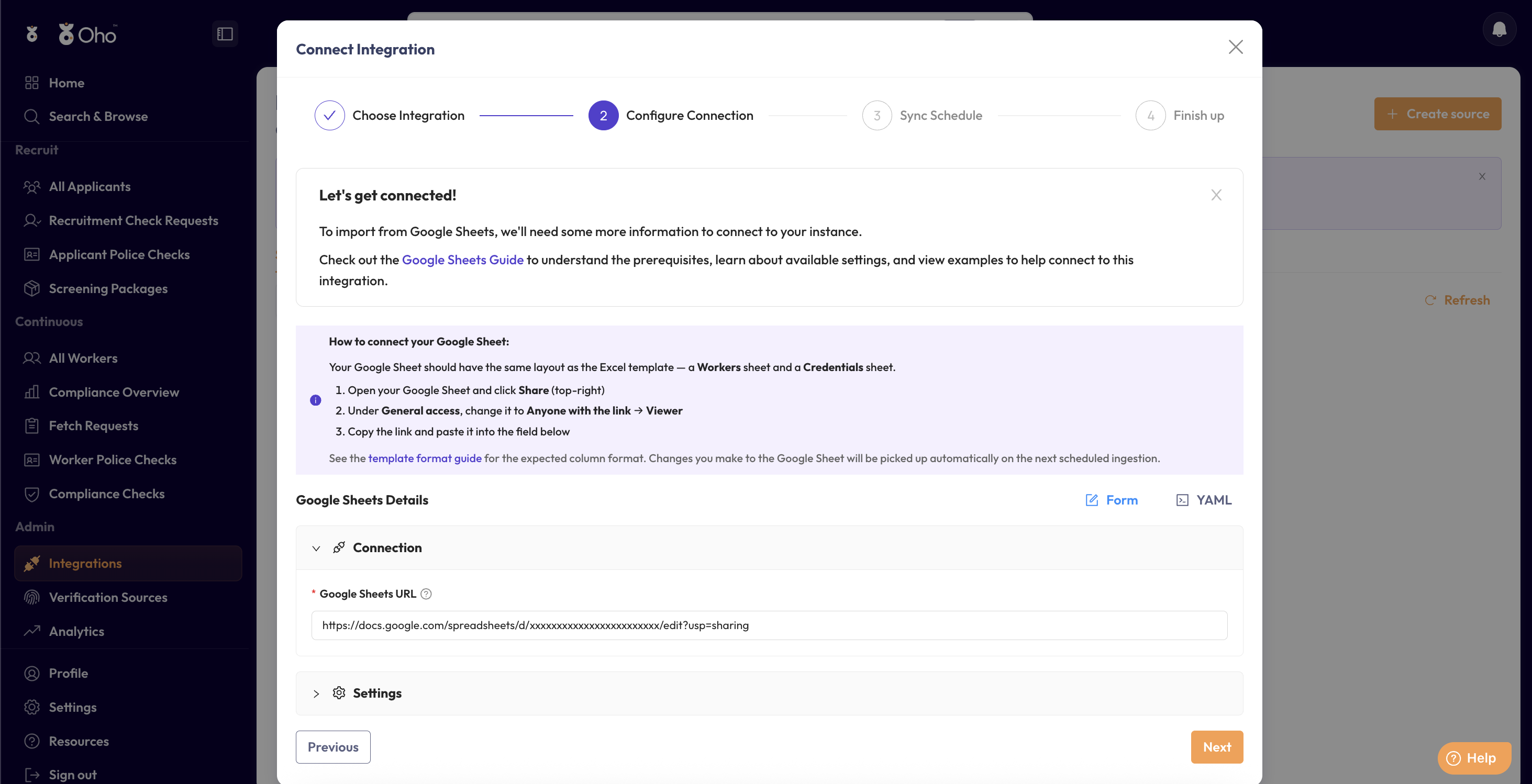
  1. Open your Google Sheet and click Share (top-right).
  2. Under General access, change it to Anyone with the link, set to Viewer.
  3. Copy the link — you'll paste it into Oho in Step 2.

Setting a Google Sheet to Anyone with the link, Viewer

This sheet holds sensitive PII — restrict the link, and revoke it after

Your sheet contains workers' names, dates of birth, and card or registration numbers. A link set to Anyone with the link exposes all of it to anyone who obtains the URL — no sign-in required — and a shared or leaked link is enough to disclose it. These are personal-information handling obligations under the Australian Privacy Principles (see Workers → Privacy & access).

To keep exposure to a minimum:

  • Use the tightest sharing that still lets Oho read the sheetViewer, never Editor — and don't reuse the link for anything else.
  • The sheet only needs to be reachable while an import runs. For a one-off import, set access back to Restricted the moment it completes. For a recurring schedule, it only needs to be reachable during the scheduled runs.
  • Never post the link in email, chat, or tickets.
  • Lock it back down afterwards — see Step 4.

Step 2: Connect it in Oho

In the left menu under Admin, click Integrations, then start a new integration.

The Integrations page in Oho

Pick Google Sheets from the list of sources.

Choosing Google Sheets as the source

Paste the share link from Step 1 into the URL field and click Next.

Pasting the sheet link into Oho

Step 3: Map the sheet

Oho reads two sheets (tabs) in the template:

  • Workers — one row per person: their names, date of birth, organisation, and Work Email.
  • Credentials — the cards and registrations they hold, one row each.

Work Email is the match key. Oho ties each credential row to its worker by matching the Work Email on both tabs, and uses it to recognise a returning worker on later runs rather than creating a duplicate. So every row on both tabs needs a Work Email, and it must be spelled the same way in both places.

Keep the column headings exactly as they come in the template so Oho can read them. For what each column expects and which are required, see the field-mapping reference.

Keep the headings unchanged

If a heading is renamed, moved, or removed, Oho can't map that column and those rows won't import. Add your data under the headings as they come — don't edit them.

Step 4: Schedule and verify

Choose how often the import runs, then name it and save.

  • Once — a one-off load to get started. Oho already has your people after it runs, so you can set the sheet's access back to Restricted straight away.
  • Recurring — Oho re-reads the sheet on a schedule, so edits you make in Google flow through automatically, with nothing to re-upload. The sheet must stay shared for future runs, so keep it on Viewer access and review periodically whether the schedule is still needed. If you turn the schedule off later, restrict the sheet at the same time.

Setting the import schedule

Once it's run, confirm your people are in: they appear under All Workers, and each credential you listed is checked against its official source straight away (see One-off verification).

If the run didn't bring everyone in, check the run history and the Common questions below.

What happens next

  • Your people appear under All Workers, ready for checks.
  • To keep those checks current over time, add a verification source for the credential types you hold — synced credentials then verify at the register automatically.
  • If you set a recurring schedule, you don't re-import by hand — edit the sheet in Google and Oho picks up the changes on the next run.

Common questions

The import found nothing. Check sharing is set to Anyone with the link → Viewer, and that you pasted the sheet's link (not a screenshot or a private URL).

Some rows didn't import. Make sure the column headings still match Oho's template, and that every credential row has a Work Email that matches a worker on the Workers tab.

I don't see Integrations. This is an admin area — if it's not in your menu, ask an admin in your organisation, or contact support@weareoho.com.